Daring
| Designer | ?? |
|---|---|
| Builder | Donald McInnis |
| Launched | 1st September 1863 at Mangawhai |
| Survey No. | 46541 |
| Registered No. | 26/1863 |
| Length | 53ft "from the fore part of the stem under the bowsprit to the aft side of the head of the stern post" Certificate of survey 7th Oct 1863. |
| Beam | 16.6ft "Main breadth to outside of plank", Certificate of survey 1863 |
| Depth | 6.8ft "depth in hold from Tonnage Deck to Ceiling of Midship", certificate of survey, 7th Oct 1863 |
| Tonnage | 31.14 tons "Tonnage under Tonnage Deck" certificate of survey, 7th Oct 1863. |
| Rig | Gaff schooner |
| Owner History | |
| Sept 1863 - Mar 1864 | John Matheson and John Rattray |
| Mar 1864 - Feb 1865 | David Kirkwood |
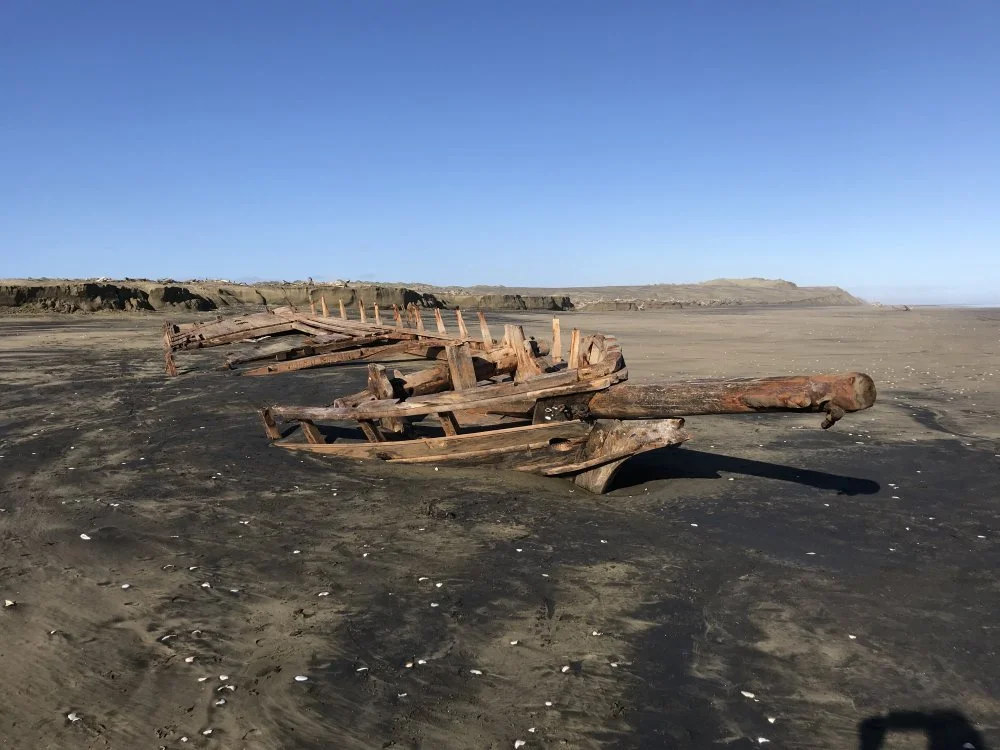
The Daring was originally recovered, with the consent of Heritage New Zealand, by the Daring Rescue Group, a group which included members of the Classic Yacht Charitable Trust. On the the 4th May 2021 the Daring was transported to Mangawhai and transferred to the control of the Mangawhai Daring Trust to continue with the preservation work and to make her available for public display to assist in telling the stories of the life and culture of the times during which she was sailing the coastlines of Aotearoa New Zealand.
How to donate
To assist in the preservation of and bringing the stories of the Daring to life please donate now by either going to our givealittle page https://givealittle.co.nz/org/mangawhai-daring-trust
or direct by bank deposit to the Mangawhai Daring Trust bank account 12 3094 0278831 00 Record Daring in 'particulars' and your name in 'reference'. If you would like a tax receipt to assist an IRD tax credit for donations email your name and amount donated to daringtrust@gmail.com
Thank you to all who have already made such valued contributions toward the long term preservation of the Daring. We look forward to hosting you at the Daring in the near future.
Project Cost
Preserving our history does not come without major expense. Our cost to date Nov 2025 is $1.4m with the estimates to complete being $2.8m. Building plans are complete and we are now at the 'shovel ready' stage.
Daring History
The Daring is a carvel planked schooner built in Mangawhai in 1863 by the young Nova Scotian boat builder Donald McInnes. She was the third boat built by Donald and was christened the Daring by his sister Miss McInnes as she was launched on a high tide following a day of storms on the 1st Sept 1863. She was built for owners John Matheson and John Rattray on 1st September 1863 and initially moved to Canterbury before being sold and moving to the Manukau Harbour where she operated as a trader along the West Coast ports of the middle North Island. The original owners sold the Daring to David Kirkwood in early 1864. On the 1st of June 1864 the Daring stranded on the south side of the bar at Waikato Heads. She was reported to be a total wreck, but insurance of 500 pound enabled subsequent repair and re-floating. On 21st February 1865 the Daring was aground again in a controlled beaching after being caught in a strong wind on a lee shore. The skipper considered this the better option rather than risking loss of boat and life on the Kaipara Bar. It was this controlled beaching under anchors that has allowed the boat to be preserved in original state and makes her the most complete vessel of the time with many build features that vanished soon after when the coastal vessels changed to the popular flat bottomed scows. Relaunching into a constant surf over following days proved fruitless and the uninsured Daring was abandoned, in tact on the beach, on 9th March 1865. Presumably cargo, masts, spars, sails and light equipment were removed and reused. The boat became buried under the sand dunes where it appears to have remained covered until becoming exposed by receding sand dunes in early May 2018. On first emerging the boat appeared to be fully intact, however over subsequent months most of the decking timber and some of the beams, including the registration beam, were souvenired by local beach goers or washed away by the relentless waves at each high tide.
An article in the Daily Southern Cross 27th Feb 1865; tells of the announcement of the grounding once Captain Phipps had walked back to Onehunga.
An article by in the Lyttleton Times dated 23rd March 1865 by David Wallace Brown, Kirkwood’s clerk, provides a full and informative account of the grounding and attempts to refloat the Daring. (scroll down midway through article for the Daring story)
An earlier article in Daily Southern Cross, outlines early information about the rescue involving up to 30 men.
Design:
The cutter rigged schooner sail plan was common for coastal trading vessels of the time and allowed for a large number of small sails to be easily hoisted or lowered by a small crew to meet varying conditions and manoeuvring needs. The Daring was a beamy vessel at 16ft 6in which allowed for large cargo capacity providing good returns for the owner. The lute stern was also a common design of the era for breaking up following seas.
Craftsmanship
The quality of craftsmanship in the Daring is stunning. The lay and set of her 2 inch planking is as good as any superbly built wooden boat of the later years of wooden boat building. The inner edges of her covering boards are beautifully scribed the full length of her decks as well as her bulwark framing. The deck and interestingly the upper planks were pitched. All joints in her timberwork were done very precisely with an array of techniques for various parts of the ship. Most of her planks are fastened with trenail or trunnel fastenings which is why she has held together so well. Some planking areas and decking are spiked onto the frames with iron dumps. the windlass has been beautifully crafted and was operated by hand with wooden spike handles. The hull was sheathed in Muntz metal to protect from the invasion of marine growth. Sawn planks and timbers have been adzed to shape to fit perfectly in position. Samples of the timbers used have been analysed by Dr Rod Wallace of the Anthropology department of Auckland University to identify the timbers used. All planks and minor timbers are Kauri and all framing elements (ribs, knees and sternpost etc) are Metrosideros (probably Pohutukawa).
The recovery Process
A Community group, "Daring Rescue", was formed in July 2018 with the ambitious view of salvaging the vessel from the beach and transporting her to storage where a preservation process could be followed prior to ultimately public display for the long term. Interest in the Daring has quickly grown throughout the wider community with interest ranging from the fact that this is likely the oldest virtually complete New Zealand built vessel, to the construction techniques used and builder, skippers, and owners histories.
The process to complete the preservation project was complicated and due to the location of the vessel involved many parties. The initial challenge was ensuring that the Daring remained as in tact as possible. Security firm Black Hawk Security has provided 24/7 security to protect the vessel from wave action (many ropes now hold the timbers together), souvenir hunters, driftwood logs and branches and recently a dead whale washing ashore. The Daring wreck lay within the New Zealand Defence Force Kaipara Air Weapons range which is out of bounds at all times. Despite this many people travelled into the Defence Force zone illegally to view the vessel. The land in the area is owned by the local Iwi Ngati Whatua o Kaipara and part is cropped by Hancock Forest Management. The Daring Rescue group obtained approval from the Iwi, Defence Force, and Forestry Company for access to the boat via forestry roads, dunes and beach.
Brent Shipman of Total Marine Services lead the recovery operation which commenced in the week 3rd Dec 2018. By the 10th of Dec 2018 machinery, 4 large and 1 small excavator and a bull dozer, were in place at the end of the forest roads ready to mobilise across a rough 6km sand track out onto the beach and south down the coast to where there Daring was trapped in the sand. Over the following three days four strops were pushed under the wreck using a sluicing pump and the vessel was readied for lifting using the 4 big excavators (2 each side) to gently lift the vessel while the small excavator was used to pull the sand away from around the vessel. The bulldozer helped pull the Daring up the beach to clear the high tide mark, with the excavators holding her up and marching in convoy either side. All of this work had to be carried out through low tides and due to the isolation of the site the recovery team stayed in a tent village they set up and provisioned in the dunes.
At every stage of the recovery assigned archaeologists and archaeologists from Heritage NZ gathered the artefacts from within and around the hull. Overall approximately 100 plastic bags of artefacts with on average 10 items in each bag were collected. Each bag has been filled with water and the artefacts are now in the process of being sorted, photographed, catalogued and having preservation strategies developed.
On the 14th December a Boat Haulage transporter travelled the 43km along the beach from Muriwai to reach the boat before low tide. The Daring was lifted by the excavators and 'walked' down to the hard sand again and was ready for loading by the time the truck arrived. Following a 45 minute turnaround the Boat Haulage truck was travelling back along the sand to Muriwai at 55kph with one very precious cargo on board. The journey from hard sand to road through the soft sand dunes at the Muriwai end of the beach took almost two and half hours using track mats to slowly creep over the sand with the assistance of tractors pulling on each of the truck and trailer units.
The Muriwai volunteer fire brigade washed the boat down and wetted all surfaces to slow drying and by early morning the Daring was off to her temporary resting place in Hobsonville where a crane was used with multiple strops set up to ease her from the truck onto blocks before propping, covering and starting a fresh water sprinkling system to slow the drying process pending further assessment to develop the next stage conservation plan.
TVNZ 1 covered the story on there 6 o'clock news December 13th 2018.
Archaeological interest
The Daring is of significant archaeological interest due to its importance in New Zealand boat building and coastal shipping history and it's in tact condition. The Daring was built 6 years prior to the Cutty Sark. Heritage New Zealand has a keen interest in and has been documenting the vessel through observation, photography, laser scanning and sampling to identify timbers used in the construction. Heritage NZ have supported Daring Rescue in working through the process of gaining approval to lift shift and preserve. This has involved developing an excavation and transport plan, obtaining professional conservator (HPFS Solutions) assessment and recommendations for treatment of the timbers and metals and appointing an archaeologist to assist in uncovering the hull contents, monitoring the excavation process, recording and documenting observations.
On the 28th November 2018 the assigned archaeologist, Simon Best, and archaeologists from Heritage NZ together with volunteer archaeologists carried out a 'dig' on the interior of the hull (to explore and record the contents of the hull), along the starboard exterior (to explore the props used to support the boat) and the sand around the vessel (to record the anchor and chain condition and location). Two trenches were excavated aft of the crew quarters. They contained in situ hessian-like sacks containing grass seed (since determined by Auckland University to be Lolium Perenne). Other objects that were uncovered during the excavation when the boat was lifted include timber plank fragments, timber chips, corroded metal, neck tie scarf, clothing, shaving equipment, smokers pipes, belts, window glass and slate. The excavation carried out on what was suspected to be an anchor, turned out to be chain only.
Conservation
The Daring Rescue group have been working with conservator Susanne Grieve Rawson of HPFS Solutions to consider the best ways to preserve the Daring for the long term. Initially Susanne was engaged to complete a Preliminary Conservation Proposal to provide a view of what could lay ahead for the conservation work once the Daring was recovered from the beach and to provide early care recommendations. Once the Daring was recovered and moved to storage (and funding became available) Susanne and conservator Sara Gainsford were engaged to complete core samples of the Daring timbers and sampling of the muntz metal. Larry Paul and Brett Evans of the Daring Rescue Group assisted with this process. The samples were taken to Victoria University where they were analysed by Susanne and David Flynn of the School of Chemical and Physical Sciences, using Scanning Electron Microscopy and Energy Dispersive Microscopy to understand the cellular structure, mineralisation, evidence of erosion bacteria, evidence of tunnelling bacteria and evidence of fungi in the timbers. The muntz metal was analysed to understand the metal composition. Results and analysis have been reported in the Post Recovery Wood Condition report.
The next step is to develop a conservation plan which will provide a template to work to over the coming years for the ongoing preservation of the vessel. This phase is currently on hold until the next funding tranche is available. In the interim the vessel continues to be kept damp to ensure the timbers don't dry too quickly and to remove some of the salts and minerals. Initially automatic sprinkler systems were set up to operate twice daily (morning and late afternoon) for 5 minutes each time. As the summer temperatures have waned this regime has progressively been reduced to initially once per day for 5 minutes, then to once per day for 2 minutes, to the current rate of once per two days by manual spray to ensure all surfaces are covered.
Susanne and Sara also completed a series of photos of the interior and exterior of the hull which Susanne is now converting into a 3D image of the vessel using photogrammetry. To date she has completed the interior images which produce an amazing view of the boat surfaces in incredible detail.
Media and community interest
Media interest has been high with several articles published in the NZ Herald, Stuff, Professional Skipper magazine and local newspapers.
John Hudson and Television New Zealand have been involved from the start of the project and have produced an amazing story around the discovery, recovery and the boat builders story. Their story "A Daring Rescue" aired on the Sunday programme on 14th July 2019.
Larry Paul, Isaac McIvor and Kurt Bennett have made many presentations to interest groups at venues such as NZ Maritime Museum, Ponsonby Cruising Club, U3A groups, West Auckland Heritage Conference, The Australian Institute of Archaeology conference and various presentations at the boat.
Our Facebook page "Daring Rescue" has had a huge level of interest from all over the world.
Watts in a name?
Interestingly Daring was not an uncommon boat name in the 19th century. There was another Daring built at Matakana in 1856. She was 55ft 7in. 35.31 ton built by W R McKay. This Daring was sold to Sydney, however was purchased by Messrs Phillpotts and Baillie of Picton in early May 1863 and returned to New Zealand arriving in Wellington NZ on 27th May 1863. This Daring shared a similar fate and was declared a total wreck at Wanganui Heads 4th April 1865 (Watts Shipping Register).
Some of her journeys
After her launch in September 1863, the Daring sailed for Canterbury on the 7th October with 25000 feet of timber aboard. She arrived (via Cabbage Bay) in Heathcote River, Lyttleton on 28th October with a cargo of 19000 feet of timber, 14 doors and 2 stoves. On the 28th October she was advertised for sale in Christchurch. She remained in Lyttleton until the 6th November when she made her way to Wellington without cargo. From newspapers of the time she appears to have plied between Wellington, Lyttleton and Timaru for several months before heading north again. On the 6th December 1863 both the 31 ton and the 35 ton Darings were recorded as being anchored in the river at Lyttleton. Her last record in the South Island appears to be her arrival in Lyttleton on 22nd December 1863.
On the 13th January 1864 The Daring was back in Auckland, after a 13 day run in ballast only, from Lyttleton under Capt. McKenzie. Upon arrival in Auckland an advertisement for cargo for her planned voyage to Taranaki was placed in the Daily Southern Cross. She departed for Taranaki with a full cargo on 3rd Feb 1864. The manifest included: 10 boxes, 1 half and 1 qr. Tierce tobacco, G.T.Lethbridge; 3 boxes tobacco, Webster & Brothers; 40 cases wines and spirits, Webster & Brothers; 2 tierces brandy, 57th regimental mess, 7 cases arms and ammunitions. C Brown; 7 cases, order; 14 gnats sugar, 7 boxes tea, 4 half-chests tea, 10 casks stout, 3 casks pearl barley, 7 cases pickles, 3 casks currants, 3 cases kerosene oil, 3 cases sardines, 3 drums colza oil, 66 bags oats, 8 mats rice, 30 bags flour, 10 cases sherry wine, 10 cases port do., 20 cases candles, 3 cases apothecary ware, 30 bags maize, 11 cases liqueurs, 7 cases merchandize, 2 cases iron. Rattray & Matheson agents
Following her arrival in Taranaki she was based at Onehunga and largely plied the central north island ports of Taranaki (New Plymouth), Port Waikato, Kawhia, Raglan and Onehunga (Manukau) until her demise in February 1865.
There is record in the Taranaki Herald that the Daring from Picton and The Daring from Manukau were once again anchored together this time in Taranaki 19th August 1864.
Owners and Skippers
The background to the owners and skippers of the Daring are an amazing story in their own right.
Donald McInnes - boat builder
Donald migrated to New Zealand from the port of Englishtown St Ann's Bay, Cape Breton Island, Nova Scotia. His boat building partners D H McKenzie and Haswells also lived and worked in the shipping and ship building industry in St Ann's Bay which was the major port and centre for the North Altantic fishery and timber trade. A wharf in the bay was operated by D H McKenzie and his cousin William Ross.
Nova Scotia was the boatbuilding capital of the world and had more mariners/shipbuilders per capita than anywhere in the world throughout the age of sail.
The migration to New Zealand from Nova Scotia was lead by the Mariners of the area and their relations some of whom were primarily farmers. Effectively they moved a whole family based community to Waipu Northland NZ motivated by several factors: Potato Famine- same as Ireland devastated crops, failures of wheat barley oats, Free trade with the US - Yankee schooners fished out the area causing fishery failure. Loss of preferential timber trade with Britain, and all of the land on Cape Breton Island had been taken up so the next generation was leaving for better promises in Australia and New Zealand.
Born about 1836 (Died 16th June 1918 at Auckland) McInnes arrived in NZ with his widowed mother Flora (nee Shaw) and his 4 siblings (John, Archibald, Norman, and Roderick) on the "Breadalbane" in1858. His father, John McInnes was a builder who passed away in Nova Scotia.
Apparently the family stayed in Auckland, but Donald remained at Mangawhai for some years building boats, including the "Daring". He had built the schooners "Abeona" and the "Three Brothers" in conjunction with Capt D.H.McKenzie prior to that (1861 - 1862). He married Mary Haswell in 1867 - her family had arrived on another of the Nova Scotian migration ships (Gertrude) in 1856.
Donald McInnes - Shipyard - where the Daring was built
Donald McInnes initially set up his shipyard in partnership with Donald Hugh McKenzie circa.1861. By 1862 the yard was well established just inside Mangawahai Heads as described in the Daily Southern Cross newspaper of 15th April 1862. The shipyard where the Daring was built, was on the land of John Smith which can be described as lots 15 and 16 which are located near the present-day office of the Mangawahi Heads Holiday Park (2024), at the bottom of Mangawhai Heads Road. (A review completed by Heritage NZ substantiates this site) This site would have had an abundance of pohutukawa and kauri available and most importantly a stream and permanent spring for water supply. Following completion of the Daring in 1863, McInnes moved to Freemans Bay in Auckland where he continued boat building completing the cutter Stag in October 1864, the 80ft 6in Maid of Erin launched Jan 1865. McInnes returned to Mangawahi and re-established his shipyard on the land (lots 15 and 16) he ultimately purchased in 1873 from John Smith. Interestingly the 85ft schooner R Tucker Thompson was launched from a similar spot in October 1985 (northern side of the boat ramp at Alamar Crescent) She had a draft of 8ft 6ins.
Captain D H McKenzie - Boat Builder and skipper
Six ships migrated from Nova Scotia. Reverend Norman, family members and his inner circle travelled on the first ship the Margaret. Five ships followed including the 5th ship the Breadalbane carrying the McInnes family. D.H. MacKenzie was second officer on board the last ship, the Ellen Lewis, which he co owned along with his cousin the Merchant and senator William Ross and John Munro jr. , the son of the owner of the “Gertrude” the 3rd ship.
Capt James McKenzie skippered the Daring on her travels south to Lyttleton and Timaru and Wellington before sailing her back to Auckland arriving 13th January 1864. While in the south D H McKenzie was presumably endeavouring to achieve a sale of the vessel per the advertisement in the Press,Vol III, issue 310 28th October 1863
Captain Samuel Phipps
After some time as crew on the Daring, Samuel Phipps took control of the Daring for his first voyage as skipper from Onehunga to Taranaki. It was on the return voyage that Phipps was forced to make the decision to beach the Daring near the Kaipara Harbour South Head on Muriwai Beach.
Samuel Phipps went on to captain other vessels. The beaching of the Daring was not a unique event as when caught in a SE hurricane the same strategy was used to successfully save the 43ton ketch Wild Duck from being wrecked at Guards Bay 5th July 1880.
Samuel Phipps died 19th Feb 1912. His wife, Alice Phipps, passed away March 19th 1937 in her 87th year.
David Kirkwood
Kirkwood, was based in Onehunga and owner of seven coastal trading ships (Abeona, Excelsior, Daring, Fairy, Little Fred, Stanley, and Thistle), purchased the Daring from owners Mcinnes, Matheson and Rattray some time around 3rd Feb 1864 when the Daring sailed with a full cargo from Auckland for Taranaki under Capt. King. Kirkwood employed many skippers on the Daring during his short period of ownership. Captain King was skipper when the Daring was wrecked at Waikato Heads in early June 1864. He remained skipper for a time after but by Sept 1864 had been replaced by Peter Iwerson late Sept 1865. By late November 1865 skippering alternated between Campbell and Davies , then Davies from Dec. 1864 until mid Feb 1865 when the helm was passed to Capt Phipps (previously mate) for his first trip as skipper from Onehunga to Taranaki then the fateful final voyage to Manukau ending on Muriwai Beach. Kirkwood led the unsuccessful attempted recovery of the Daring from Muriwai Beach.
Television NZ news item 13th Dec 2018
Television NZ Sunday programme story
Stuff news report 30th May 2018
NZ Herald 7th April 2021:
TVNZ - One News item on arrival of the Daring in Mangawhai 4th May 2021
HammerHead Visuals and Elevated Media NZ video of the Daring arrival of the Daring 4th May 2021
Hammerhead Visuals and Elevated Media NZ the return of the Daring
NZ Herald Northern Advocate article on the arrival of the Daring in Mangawhai 4th May 2021
Elevated Media NZ and Hammerhead Visuals video on display in the exhibition at Mangawhai Museum
Thank you to our partners: